We might not think of animals as clever enough to be creative, but this footage suggests otherwise. A group of Orca wales line up and swim in, in formation so that they create a bough wave that is big enough to flip the ice. Their reward is fresh seal.
More surprising still is the fact that sometimes the seals aren’t eaten. They are allowed to climb back on the ice and the Orcas have another go. In other words, they seem to be doing it just for the practice, or the sport.
We think of the British as the great creators of new sports. Rugby, cricket, badminton, Eaton fives, tennis, and football. Perhaps the animal kingdom has actually out performed us in creating new sports.
There are other examples of creativity in the animal kingdom too. Monkeys that send in smaller monkeys from other species to pick nuts out of small crevices. They then ‘mug’ the smaller monkey and get the nuts.
If you gave a creative team the above problems to solve, how long would it take them to come up with an answer?
There are so many ways change and communications are related. And a corollary of this idea is that if you want to create a big communication, you need to find a really big change to champion.
That may be easy if you’re Martin Luther King, but what if you’re a mid-market soap brand?
What sort of change can you go for?
So not the kind of change that goes 10% off all cocoanut formulations this July. How about we’re going to change the relationship of women to their feelings of self-worth?
This is the task Dove sets itself and the size of its ambition for change means people always get its communication.
What are the big, ambitious, hairy goals you’ve set to change with your product good or service?
Have a look there and you’ll be on the path to some great bits of communication.
 Tim Riley was one of people who was kind enough to give me some coaching and critiques when I was trying to land my first job in advertising.
Years later he also sat down with me over a cup of tea at the Landmark hotel to help me sort out the content and aims of the Copycourse.
You might know his work from, amongst other things, the most clicked on Sainsbury’s ad for 2014, based on the true story of when the Germans and the British started playing football on Christmas day, from behind the trenches. See above.
He also penned the following words of advice on writing copy (below). Almost two decades old, and coming from a pre-digital age, it still stands up for its no-nonsense tonality, and humility.
“I have a confession to make, and it’s an unusual one for a copywriter. I don’t like writing copy. This isn’t as much of a problem as you might think, though. Because the truth is, nobody likes reading copy either.
People buy magazines to read the articles, not the ads. You’re lucky if people notice your work at all. So I always try to make the headlines tell as much of the story as possible. (Consequently, I end up with some very long headlines.)
Occasionally though, there’ll be ads where writing detailed copy is unavoidable. What do you do then? You get somebody to help you. When I was a junior at BMP, there were three very good writers, Alan Tilby, Dave Watkinson and Alan Curson, who were patient enough to read through my copy and suggest improvements.
Never was this more eloquently done than when Al Tilby looked at what I’d written, carefully tore it in half, then in half again, and let the pieces gently flutter into his wastepaper bin. ‘You can do better than this,’ he said. I did. The other way I learnt was by reading old ads, over and over again.
One I always admired was the Health Education poster: ‘This is what happens when a fly lands on your food.’ I liked the way the writers, Charles Saatchi and Michael Coughlan, made the story so compelling with such a deadpan, factual style.
In 73 words of copy they use only one adjective. (And the one they do use, ‘runny’, is a killer.)
Old ads aren’t the only things you can read for inspiration. Given a poster to do about Michael Jordan, Andy McKay and I found an article about him in an old copy of American Esquire. At one point, the author described Jordan’s game as ‘an ongoing dialectic with Isaac Newton’.
Once we’d looked up ‘dialectic’ in the dictionary, it was a short step to ‘Michael Jordan 1 Isaac Newton 0’. But perhaps the best advice on actually writing copy comes from an ad. It was written for VW in 1962 by, I think, John Withers. Underneath the headline, ‘How to do a Volkswagen ad’, the copy concludes: Don’t exaggerate.
Call a spade a spade. And a suspension a suspension. Not something like ‘orbital cushioning’. Talk to the reader, don’t shout. He can hear you. Especially if you talk sense. Pencil sharp? You’re on your own.”
An elegantly told story about a great design agency. Economical, engaging and very watchable.
The Forty Story from Pentagram on Vimeo.
Creativity often starts with asking what’s so obvious about something you’ve stopped noticing it. Just getting clear about the bleeding obvious is an amazingly refreshing exercise.
Here’s Michael McIntyre on the obvious things in the world, looking at things like eye glasses with fresh un american eyes. Enjoy.
What’s it like when the client is messing with the creativity? A parody old timers will recognise. Thanks to Camilla Honey at jfdi for spotting.

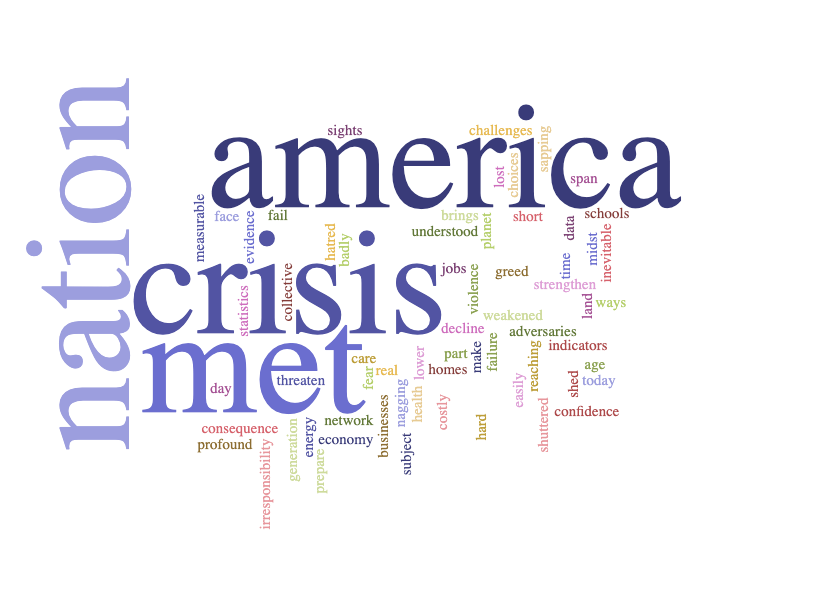
One of the recurrent issues when writing for corporations is the avoidance of anything that might look like a problem. Anything “negative” frequently provokes a squeamish response from the writing team who are sometimes programmed to say only “positive” things. Yet without the negative there is no positive, it’s all a slushy mush. And you’re never going to move or inspire anyone with mush.
But pain is a flip side of pleasure, and communicators need to work with both.
In a musical parallel, J.S Bach’s aim in his church scores was to move and inspire. So he gives us the most searingly beautiful aria from the St John Passion, where dissonant chords, tucked away in the music for fleeting moments, provoke subliminal anxiety that gets resolved later on. This becomes the motor of inspiration.
Howard Goodall’s brilliant analysis of Bach’s music could equally be applied to dealing with a piece of writing. It is especially true in writing for professional services that there are nearly always problems or a lingering pain that triggered the need for some kind of solution. Problems needs to be there, not in your face, but definitely in there, and woven in. Without problems, there’s no need for anyone to buy a product that solves a problem. Without the pain, or passion, (which means pain), there can be no inspiration.
And if you’ve never heard “Zerfliesse miene Hertz” before, you’re in for a treat.
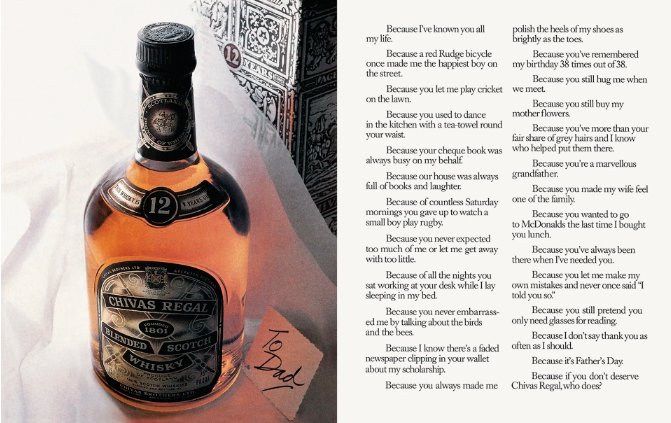
Because I’ve known you all my life.
Because a red Rudge bicycle once made me the happiest boy on the street.
Because you let me play cricket on the lawn.
Because you used to dance in the kitchen with a tea-towel round your waist.
Because your cheque book was always busy on my behalf
Because our house was always full of books and laughter.
Because of countless Saturday mornings you gave up to watch a small boy play rugby.
Because you never expected too much of me or let me get away with too little.
Because of all the nights you sat working at your desk while I lay sleeping in my bed.
Because you never embarrassed me by talking about the birds and the bees.
Because I know there’s a faded newspaper dipping in your wallet about my scholarship.
Because you always made me polish the heels of my shoes as brightly as the toes.
Because you’ve remembered my birthday 38 times out of 38.
Because you still hug me when we meet.
Because you still buy my mother flowers.
Because you’ve more than your fair share of grey hairs and I know who helped put them there.
Because you’re a marvellous grandfather.
Because you made my wife feel one of the family.
Because you wanted to go to McDonalds the last time I bought you lunch.
Because you’ve always been there when I’ve needed you.
Because you let me make my own mistakes and never once said I told you so
Because you still pretend you only need glasses for reading.
Because I don’t say thank you as often as I should.
Because it’s Father’s Day:
Because if you don’t deserve Chivas Regal, who does?