By Gideon Todes and Katryna Turner
content, SEO, Thought leadership
A few years back Jamie Oliver did an expose on Turkey Twizzlers, mechanically recovered meat that was both cheap to produce, had very little nutritional value, bore little relation to any real turkey and was satisfying to children, but not in a particularly healthy way.
And where nutrition goes, so too does information. As we enter the AI age, it’s possible to produce content for the sake of marketing in a comparable way as Turkey Twizzlers.
Highly engineered for a particular palate, in this case the google search engine, low on real information and authenticity. The other similarity is that the more you investigate how it’s produced the less appealing it becomes.
Slop text and junk food share many attributes. You read slop and it leaves you with the sensation that you’ve read something, but the content hasn’t really told you very much. There will be a lot of on one hand …and then again on the other, with a good sprinkling of the famed em dashes, but real content with opinion and personality will be hard to find.
 If you’re using AI to help you write, the food analogy is helpful.
Where cooking a pie is time intensive you can always buy one ready made. If it lacks a little authenticity you can add some of your own herbs to help that fresh flavour that factory food can’t replicate.
One person I know takes a certain brand of fish pie, and because he considers their offering a bit short on real fish, adds some actual fish under the crust.
You can do the same with writing with AI. Add some personally harvested information and suddenly the somewhat anodyne writing feels more authentic and better researched.
Just like fresh herbs, fresh content is the hardest thing for a machine commoditising process to emulate.
A particular interview with a particular point that illustrates a more general issue is what distinguishes an authentic piece of writing, say by a first rate journalist, from the run of the mill AI slop.
All of this is well understood by the AI tech giants and this year Google has raised its game and created its EEAT update. EEAT in case you aren’t aware of the acronym, stands for Experience, Expertise, Authority and Trust. In other words, the search engine system wants to see named authors with a history of expertise in the field showing their experience and expertise before they send their search clients to your site.
How deep this goes is yet to be seen but google will integrate your EEAT score with the bounce rates to see how your content stacks up.
One thing we’ve noticed is that the quality of content writing is already showing an improvement. Some of the more obviously sloppy content is already disappearing and being replaced with visibly more muscular informative content.
One area of interest for the authors is professional services: How will AI affect the content that supports marketing for these?
If you are looking for your next consultant to do that big engagement, it helps if their organisation puts out engaging relevant insightful content. Too much slop and you might question their credentials even if their brand history suggests deep sector knowledge.
As you bring an editor’s eye across material from various places, there are some good performers doing it better than others.
Goldman Sachs seems to have effectively a mini broadcast station on Youtube where it makes use of its expertise in nicely produced intelligent content. The written content stands out as a quality offering too and the mix of original content, and a clear point of view means that this is way above the slop fare. A review of McKinsey’s content by contrast was disappointing. Quite a lot of obviously self serving content that is lacking a journalistic feel. This had a more consultant style of writing, but a consultant who doesn’t want to divulge the real story.
Use a bot to spot a bot
For a bit of fun and to develop a tool, the authors of this paper enlisted the help of Claude, our friendly AI bot and developed our own tool for evaluating content.
We started by asking Claude for a definition of AI Slop. We then asked it to build a tracker table of all the slop and not slop we were feeding into it. 0 represented original human form nutritious content, and 10 was max slop.
We also experimented with taking text that was AI generated, and adding human sourced content into it.
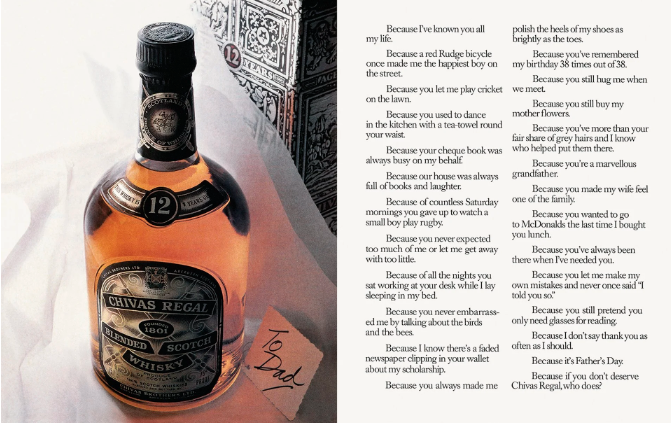
For comparison, we put David Abbott’s famous Chivas regal copy into the AI slop tracker. This masterpiece of copywriting was created 10 years before Tim Berners Lee had even conceived his hyper text language.
David Abbott, Chivas Regal ‘Father’s Day’, 1980 — Abbott Mead Vickers / DDB
The deeply personal granular information, the way the text operated between the lines meant that perhaps unsurprisingly the AI Slop factor was determined to be zero.
But on the kind of texts that would have Abbott turning in his grave, the AI Slop factor was considerably higher.
These were the results. But you can ask Claude to do similar for any piece of text you chose,
Slop factor tracker — professional services & advertising
| Lowest Slop factor | Category | Score | Key reason for score |
|
David Abbott, 1980 — Abbott Mead Vickers / DDB |
Advertising | 0.5 | Repeated ‘Because’ paragraphs, 285 words, brand named once. Autobiographical, pre-AI, zero filler. Half-point only because zero isn’t on the scale. |
|
When AI learns how the world works Goldman Sachs |
Finance / research | 1.5 | Named authors (Lee, Keyserling), named researchers (LeCun, Li, World Labs), genuine thesis on world models vs LLMs. Earns its length. |
|
Beyond the Employment Rights Act — NDA consultation Freshfields |
Legal | 1.5 | Named partners (Mendel, Carruthers), specific legislation (s.202A ERA 2025), 8 July 2026 deadline cited. Dry but zero padding. |
|
Where are gas prices actually squeezing spend? Consumer Edge |
Data / research | 2.0 | Named author (Gunther, SVP Research), proprietary transaction data, counterintuitive CA vs AZ thesis. Stops where paywall begins. |
|
2026 Global M&A industry trends PwC |
Consulting | 2.5 | Named authors, specific megadeal counts (26 tech, 13 banking), OECD projections cited. K-shaped framing is sharp. Some M&A boilerplate. |
|
AI-first mission: reimagining professional services PwC |
Consulting / AI | 2.5 | Sharp framing (‘AI extends expertise, judgment creates value’) but light on evidence. Brand narrative with no survey data or named authors. |
|
Economic conditions outlook, Dec 2025 McKinsey |
Consulting / macro | 3.0 | 1,011 respondents, 81 nations, named author (Sven Smit). Quarterly template is formulaic; hedged to vagueness in places. |
|
GT unveils AI tool pairing pros with agents Grant Thornton |
Accounting / PR | 6.5 | Named quotes but almost every line is brand language: ‘world class service,’ ‘ever evolving commercial and technology landscape,’ ‘unlock new opportunities.’ Press release genre, but the slop density is high. |
|
HR trends to watch in 2025: building the human-centric workplace Workday |
HR tech / B2B | 7.5 | No named authors. Dense with ’empower your workforce,’ ‘ever-changing landscape,’ ‘thrive in 2025 and beyond.’ Cites ‘according to research’ without attribution — three times. Product-led lead-gen dressed as insight. |
|
HR trends in 2025: what’s shaping the future of work? Staffbase |
HR tech / B2B | 8.5 | Opens ‘Human resources is a dynamic field, constantly evolving.’ ‘Blockchain is a game-changer for HR.’ ‘Drive meaningful change.’ Anonymous authorship, every section an SEO checklist. References ‘a recent Forbes article’ without linking it. |
| Highest slop factor | |||
A couple of trends are becoming clearer.
First, as the cost of producing TV and written content comes down, you no longer have to be a broadcasting organization to do it. Anyone with a higher level iphone and a microphone and a quiet office can do it.
A Goldman Sachs type operation with its highly paid, highly motivated workforce can with a little effort start to eat the lunch of business broadcasting channels with their in-house efforts.
The second thing that is emerging is that just as AI is helping produce slop, other forms of AI will, like we have just done, be used to weed it out.
So rather than seeing AI as the tool that creates the noise, it could focus us humans on producing more fresh content.
But you don’t have to have a Goldman Sachs budget to be able to do less sloppy things. One of the recent content activities your author has been engaged in recently is doing zoom interviews with end user clients. Intercut that with end user social content and you get some real content bangs for buck. See this short video profile.
This turns out to be quite useful beyond EEAT. Talking to customers is always a great idea and grabbing content, understanding targets and tidying up any user feedback issues can all be done in one interview.
So rather than seeing AI as the ushering in a sewerful of sloppage, there is a more positive take: We can see it as a tool that’s part of a dynamic equilibrium, between machine and human interaction, and between commoditisation and individuality.
It’s not only less depressing to see it that way, it’s probably a more accurate representation of what’s going on in our world.
Far from being a race to the bottom the AI take over of content might just become a slow wobble to the top.
Abbott at his deeply personal best