It's the pain that makes the inspiration.

By Communications craft, content, Uncategorized


One of the recurrent issues when writing for corporations is the avoidance of anything that might look like a problem. Anything “negative” frequently provokes a squeamish response from the writing team who are sometimes programmed to say only “positive” things. Yet without the negative there is no positive, it’s all a slushy mush. And you’re never going to move or inspire anyone with mush.
But pain is a flip side of pleasure, and communicators need to work with both.
In a musical parallel, J.S Bach’s aim in his church scores was to move and inspire. So he gives us the most searingly beautiful aria from the St John Passion, where dissonant chords, tucked away in the music for fleeting moments, provoke subliminal anxiety that gets resolved later on. This becomes the motor of inspiration.
Howard Goodall’s brilliant analysis of Bach’s music could equally be applied to dealing with a piece of writing. It is especially true in writing for professional services that there are nearly always problems or a lingering pain that triggered the need for some kind of solution. Problems needs to be there, not in your face, but definitely in there, and woven in. Without problems, there’s no need for anyone to buy a product that solves a problem. Without the pain, or passion, (which means pain), there can be no inspiration.
And if you’ve never heard “Zerfliesse miene Hertz” before, you’re in for a treat.

Anglo Saxon, Latin and political Polyfilla.

By Communications craft


Boris explains why clarity demands more Anglo Saxon and less romance based English words, and why so few politician like to do this.
“What people listen to are simple Anglo Saxon words that correspond to objects in the real world.” “When you’re not doing that it’s about an unwillingness to be honest about the issues.”

Customer Journey

By Strategy

How does a customer come to be a customer? That is obviously the key question for a marketing person, because marketing is about making the journey to the cash register as smooth and as solid as possible, and supporting it with good content.
But in a world of abundant google analytics it’s easy to think that just because something is easy to measure precisely, there’s no need to measure, or even think about measuring anything else. That I believe is a big mistake. In real life people weave in and out of the digital world in a manner of their choosing, not necessarily according to your official customer funnel diagram. In fact the customer funnel is an illusion. A better model might be a pin ball machine or a tornado spout. (It’s even been described recently as a pretzel).

Someone clicks through the site and then drops off your analytics trail. But how do you know they didn’t then pick up the phone and speak to one of your agents before placing an order? You don’t.
They read your content and go to a competitor site. A day later they tell their client, with a different IP address about both. Their client then invites you to tender. How do you track that journey? It’s tricky.
But you can ask questions. Simple questions from your sales agents taking inbound calls, like “How did you get our number?” or “Have you found anything interesting on our website?” It’s not easy but I think it’s time we tried harder to build a fuller richer picture, one that bridges the digital and the real world. We need to remember that analytics are a great tool, but they’re only half the story.
Until we have this, we’ll have all the precise answers, they just won’t be for the questions that really help us.

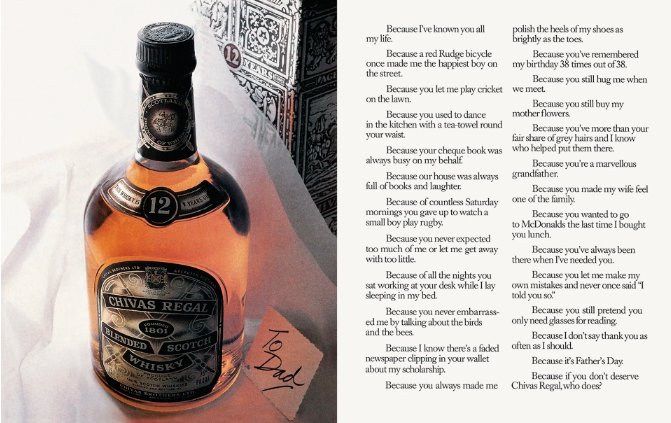
David Abbott Chivas Regal Copy

By Uncategorized

Because I’ve known you all my life.

Because a red Rudge bicycle once made me the happiest boy on the street.

Because you let me play cricket on the lawn.


Because you used to dance in the kitchen with a tea-towel round your waist.

Because your cheque book was always busy on my behalf


Because our house was always full of books and laughter.


Because of countless Saturday mornings you gave up to watch a small boy play rugby.

Because you never expected too much of me or let me get away with too little.


Because of all the nights you sat working at your desk while I lay sleeping in my bed.

Because you never embarrassed me by talking about the birds and the bees.


Because I know there’s a faded newspaper dipping in your wallet about my scholarship.

Because you always made me polish the heels of my shoes as brightly as the toes.


Because you’ve remembered my birthday 38 times out of 38.


Because you still hug me when we meet.

Because you still buy my mother flowers.


Because you’ve more than your fair share of grey hairs and I know who helped put them there.

Because you’re a marvellous grandfather.


Because you made my wife feel one of the family.


Because you wanted to go to McDonalds the last time I bought you lunch.


Because you’ve always been there when I’ve needed you.


Because you let me make my own mistakes and never once said I told you so

Because you still pretend you only need glasses for reading.


Because I don’t say thank you as often as I should.

Because it’s Father’s Day:


Because if you don’t deserve Chivas Regal, who does?

Darwinian symmetry

By content, Creativity, Uncategorized

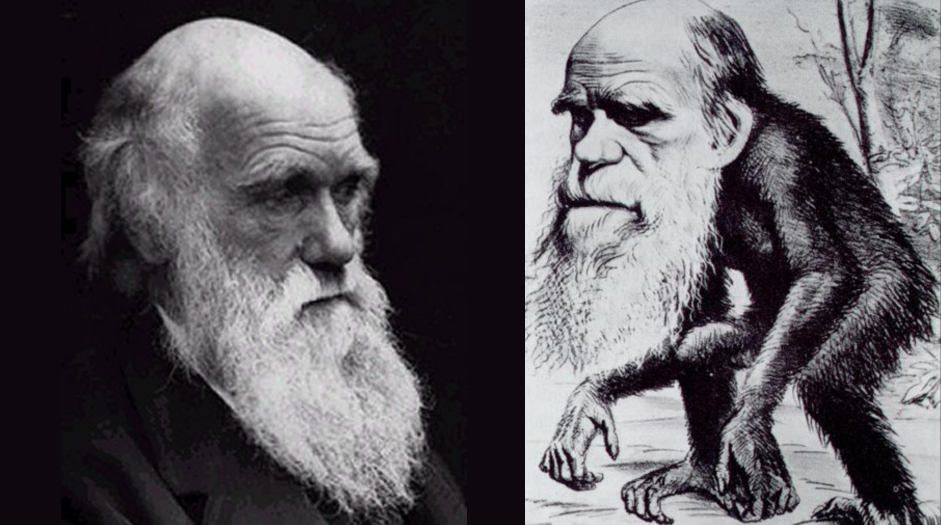
Darwin’s vision of man and ape as separated only by a few millennia meant that essentially we were on the same footing as animals. This implicity challenged relationships such as father son and holy spirit. It’s hard to be a creative thinker without upsetting people because when you spot new symmetries you disturb existing ones.

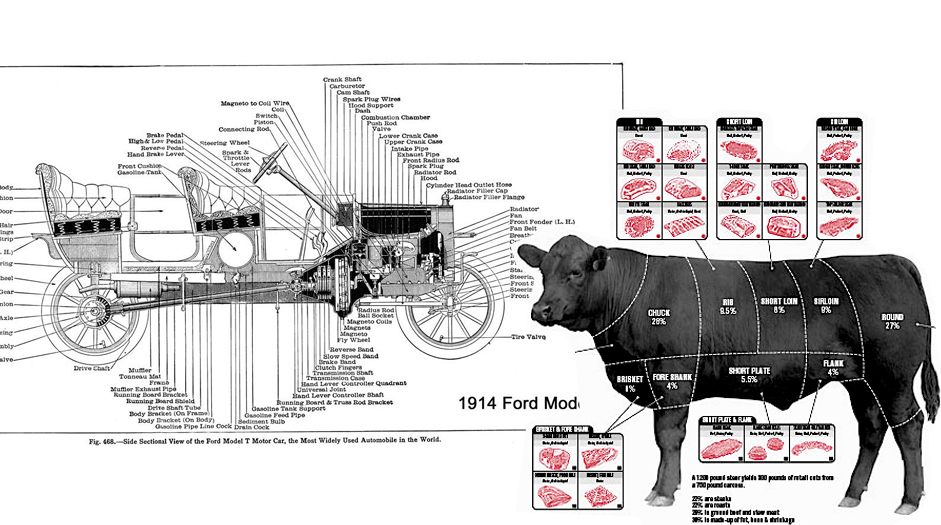
Car and cow. Ford’s symmetry.

By content, Creativity

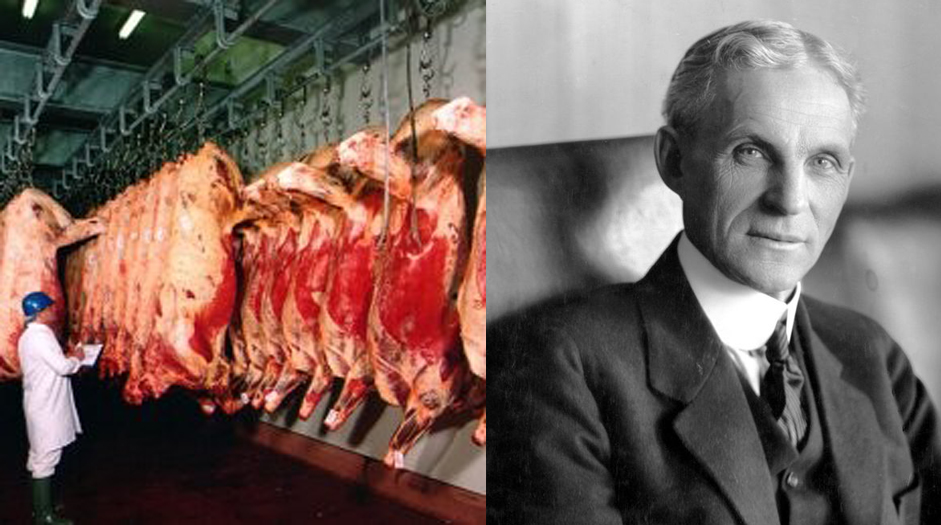
Henry Ford famously used the paradigm of meat packing to find a better way of building a car. Essentially it inverted the notion that mechanics walked around a single car, gradually constructing it over a period of months. Under Ford’s system, it was the converse; cars proceeded like cow carcasses from one specialised process to the next. Where cows were disassembled, cars were being assembled. By seeing a car as a relatively low value object he could transform its production, and produce the world’s first high volume automobile.
Ideas mean new symmetries

By Communications craft, content, Creativity

The pregnant man visual (top right) was part of an Health Education Council to reduce unwanted pregnancies. The headline ran “Would you be more careful if it was you that got pregnant?” Copywriter Jeremy Sinclair, (Saatchi’s). By exploiting the symmetry of an imaginary situation, there’s an unarguable case for being more careful with contraception.
Below, bottom left, mushroom as jet engine. This visual idea was used both by British Airways to sell its food services, and also by HSBC to discuss organic fuel sources in the future. The BA idea ran “Before we fuel the aircraft, we fuel the passenger”. The HSBC campaign creatively recycled it, with the line “In future, we will all fly organic.” Anyway, the point is that strong ideas discover and exploit meaningful symmetry. See conceptual symmetries and Darwin

See also Ideas

Good enough to seek out

By Strategy

If anyone doubts the value of good content, you only have to start looking at the modern customer journey and how it operates to see the importance.
People no longer expect to meet, greet and chat to you to make up their minds.
They effectively start their buying decision process in cyberspace, clicking around and forming an opinion about your brand. 70% of the decision is made before they meet your first actual agent.
This has huge implications for content.
The obvious one being that if you do it well, you can bring someone into an appreciation of your brand and offering in a more automated way and with fewer sales agents.

But there’s a flip side, too: you can’t really afford to do it badly. If you do, what starts as a customer journey set for a sale with you, could spin of into a sale with someone else.

And where average or adequate content that ticked a few boxes would suffice a few years ago, now that content has to be good enough that people seek it out.
Or that Google seeks it out.
Effectively what Google and the modern consumer is asking every company to become is its own broadcasting channel and or newspaper.
And that doesn’t always come easily to many corporations.
It requires mining into the organization to find the genuinely interesting things to say, and sharing knowledge that helps the consumer make up their own minds.
It requires generating fresh material with fresh insights and points of view.
And it requires treating your customers as equals.
And it involves sharing knowledge and information with the outside world, information that sometimes seems hard enough to share internally. But then that is what the sharing economy is really about.

Case studies and professional organisations

By Case Study, Communications craft, content


We all know that factories produce widgets. Or cans of fizzy soft drink, cars, smartphones and television sets, but what do professional organisations produce? If you show a car in a car showroom, you can get people to buy the vehicle; but what is the show room for the professional product?
If you ask the company they will tell you they produce solutions. But solutions tend to be invisible. They’re the lack of something; if you hold a solution up to the light, it’s usually colourless liquid.
It’s sometimes helpful to think of professional organisations as producing narrative. Either deliberately (PR agencies) or, as a by product of solving their client’s headaches. So if you’re, say a law firm, management consultancy, housing association or medical practice, these narratives can be stories of how various solutions came into being. The good news is they are usually very interesting stories. The bad news is that you have to work quite hard at retrieving them.

TED topics for Industry 4.0

By B2B, Communications craft, content, Strategy, Thought leadership, What's out there now

Thought leadership has been a buzzword for a little while now.
To do it well you famously have to be able to have thoughts and also to lead. Neither of those two things are particularly easy things to do. For many content producers, it may feel like a big mountain to climb. They way to succeed is to break it down and get a little help.
Imagine you have to create a TED talk for your product or brand. What would it talk about? What are the big themes that operate around your product or brand that you personally find fascinating? Still stuck? Ok, try something simpler, treat it as an exercise in curation.
Just make a list of existing TED talks that seem to discuss topics near to the issues close to the brand. Then, write a few comments or remarks that bridge any relevant issues that need connecting. Here are some of mine for a company that’s designing software for a modern business. They deal with what’s generally called user centred experience. The connecting comments simply need to answer the question, “What’s the relevance of this inspiring video to what these guys actually sell?” Even if it’s obvious, it’s good to make it explicit so you don’t leave your audience in the fuzzy further reaches of philosophy.